Most people do not spend much time reading their auto insurance policy.
They look at the premium, make sure the bill is paid, and move on with their day. That is completely understandable. Insurance policies are not exactly light reading.
The problem is that the worst time to discover a coverage gap is after an accident.
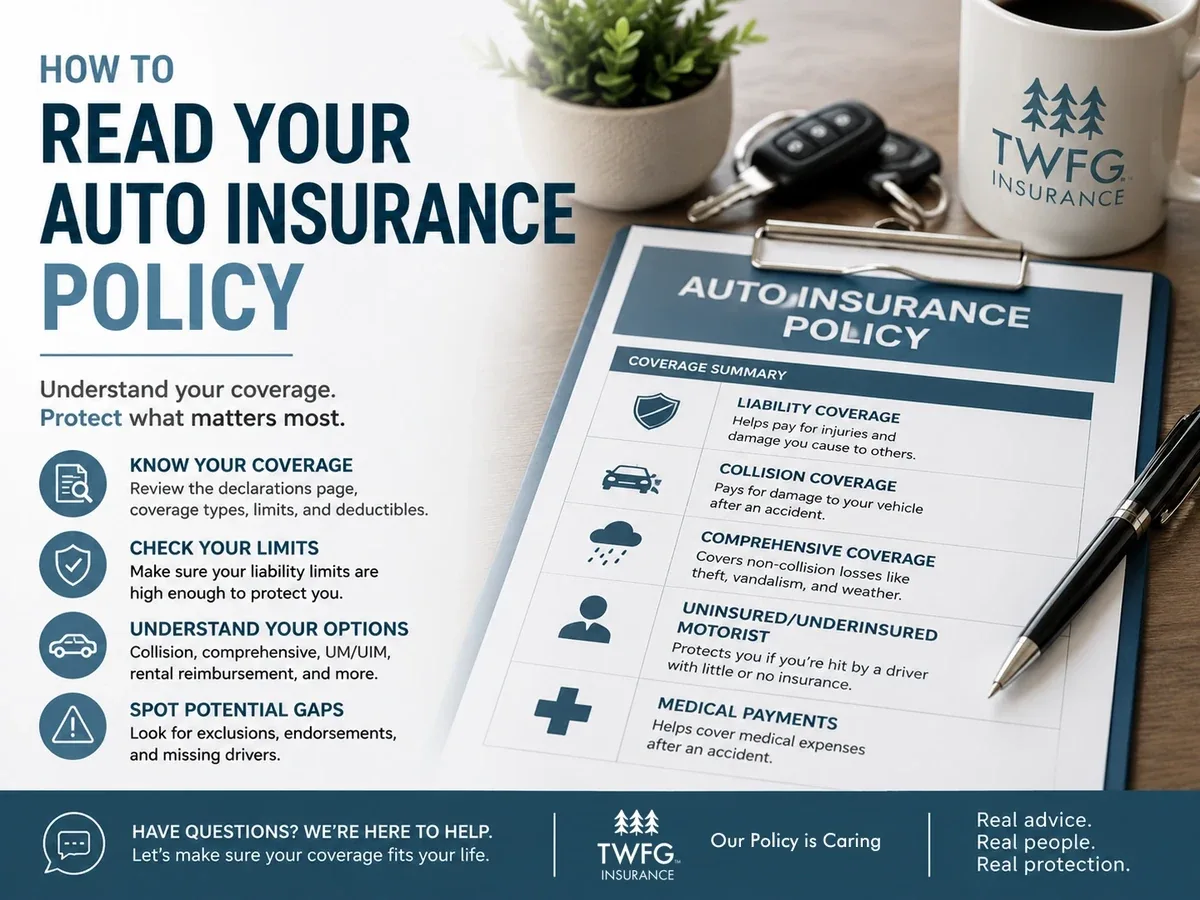
At TWFG Insurance Services, we believe you should understand what you are paying for before you need to use it. You do not have to memorize every page of your policy, but there are a few sections worth reviewing.
## Start With the Declarations Page
The declarations page is usually near the front of your policy packet. Think of it as the summary page.
It should show:
* Your name and address
* Your policy number
* The dates your coverage begins and ends
* The vehicles insured on the policy
* The drivers listed on the policy
* Your coverage limits
* Your deductibles
* Your premium
* Your lienholder or leasing company, if applicable
Start with the simple things.
Make sure the vehicles are correct. Check the year, make, model, and vehicle identification number. Make sure your address is accurate and that the people who regularly drive your vehicles are properly listed.
If you recently bought a car, sold one, paid off a loan, moved, or added a teenage driver, let your agent know.
Small details can turn into big problems if they are not corrected before a claim.
## Understand Your Liability Limits
Liability coverage is one of the most important parts of your auto insurance policy.
It helps protect you if you cause an accident and someone else is injured or their property is damaged.
Your policy may show your liability limits like this:
**100/300/100**
That generally means:
* Up to **$100,000** for bodily injury to one person
* Up to **$300,000** for bodily injury to everyone injured in the accident
* Up to **$100,000** for damage to someone else’s property
Liability coverage may help pay for medical bills, lost wages, vehicle repairs, property damage, and legal defense costs after a covered accident.
A lot of people ask us for the cheapest policy available. We understand why. Nobody wants to overpay for insurance.
But price should not be the only question.
The lowest premium does not help much if your liability limits are not high enough after a serious accident. Medical costs and vehicle prices are much higher than they used to be. It does not take a catastrophic wreck to create a claim that exceeds a basic limit.
When reviewing your **auto insurance coverage**, ask whether your liability limits are enough to protect your income, your savings, your home, and the assets you have worked hard to build.
## What Happens if Your Liability Coverage Runs Out?
Your insurance company does not necessarily pay every dollar of a claim just because you have insurance.
It pays up to the limit shown on your policy.
For example, imagine that you cause an accident and one person is seriously injured. The claim totals $250,000, but your policy only provides $100,000 of bodily injury liability coverage per person.
Your policy may pay up to the $100,000 limit. You could still be responsible for the remaining amount.
This is one reason we often talk with clients about an **umbrella insurance policy**.
An umbrella policy can provide an extra layer of liability protection above your home and auto insurance policies. It is especially worth discussing if you own a home, have savings, own rental property, have a teenage driver, or simply want stronger protection.
## Collision Coverage Protects Your Vehicle After an Accident
Liability coverage helps protect you when you damage someone else’s vehicle.
Collision coverage helps pay for damage to your own vehicle after an accident, subject to the terms of your policy and your deductible.
Examples may include:
* Hitting another vehicle
* Backing into a pole
* Hitting a guardrail
* Running into a mailbox
* Rolling your vehicle
* Damage from a single-car accident
Collision coverage usually includes a deductible.
If your car has $5,000 in covered damage and your collision deductible is $500, you would generally be responsible for the first $500.
A higher deductible may lower your premium, but make sure it is an amount you could comfortably pay if an accident happened tomorrow.
## Comprehensive Coverage Is for More Than Collisions
Comprehensive coverage is sometimes listed as “other than collision” coverage.
It may help pay for certain types of vehicle damage that are not caused by a wreck.
Examples may include:
* Theft
* Vandalism
* Fire
* Hail damage
* Windstorm damage
* Falling objects
* Damage caused by an animal
* Certain glass claims
If you hit a deer, that would generally fall under comprehensive coverage rather than collision coverage.
Comprehensive coverage usually has its own deductible, which may be different from your collision deductible.
## Be Careful With the Phrase “Full Coverage”
We hear the phrase “full coverage” all the time.
The problem is that “full coverage” is not a specific insurance coverage.
Most people use the phrase to mean they have liability, comprehensive, and collision coverage. That may be a good starting point, but it does not mean every possible loss is covered.
A policy described as “full coverage” could still have:
* Low liability limits
* A high deductible
* No rental reimbursement coverage
* No roadside assistance
* Limited uninsured motorist coverage
* No loan or lease payoff protection
* Important exclusions
Instead of asking whether you have full coverage, ask what your policy actually covers.
That is a much better question.
## Uninsured and Underinsured Motorist Coverage Matters
You may be a safe driver. You may carry good insurance. Unfortunately, you cannot control the person driving next to you.
Uninsured motorist coverage may help protect you if you are injured or your vehicle is damaged by someone who does not have insurance.
Underinsured motorist coverage may help when the other driver has insurance, but their liability limits are not high enough to cover the loss.
This coverage may also apply in certain hit-and-run situations, depending on the policy and the state where the accident occurs.
Uninsured and underinsured motorist coverage can be easy to overlook, but it deserves a serious conversation with your agent.
## Medical Payments Coverage
Depending on your policy and the state where you live, you may see medical payments coverage or a similar option.
Medical payments coverage may help with certain medical expenses after an accident, regardless of who caused it, subject to the policy terms and limits.
This can be especially helpful with expenses such as deductibles, copays, or medical bills that arise shortly after an accident.
The details vary by state, so ask your agent how the coverage works where you live.
## Rental Reimbursement Coverage
If your vehicle is damaged in a covered accident, you may need a rental car while repairs are being completed.
Rental reimbursement coverage can help with that expense.
Your policy may show a limit such as:
**$40 per day / $1,200 maximum**
That means the policy may pay up to $40 per day, subject to the maximum amount shown.
Rental car prices have increased, so it is worth checking whether your limit is realistic. If you drive a larger SUV, a truck, or a vehicle needed for your family, a low rental limit may not go very far.
## Roadside Assistance
Roadside assistance may help when your vehicle leaves you stranded.
Depending on the insurance company, it may include services such as:
* Towing
* Battery jump-starts
* Flat-tire assistance
* Lockout service
* Fuel delivery
* Certain roadside emergencies
This coverage is often inexpensive, but it is still worth asking what is included.
You may already have similar benefits through your vehicle manufacturer, a roadside membership, or another service.
## Do You Need Loan or Lease Payoff Coverage?
A totaled vehicle can create a financial surprise.
Your insurance company generally pays based on the covered value of the vehicle, not necessarily the amount you still owe on your loan.
If your loan balance is higher than the value of the vehicle, you may be left paying for a car you can no longer drive.
Loan or lease payoff coverage, sometimes called gap coverage, may help reduce that difference, subject to the policy terms and limitations.
If you recently purchased or leased a vehicle, ask whether this coverage makes sense for you.
## Read the Endorsements and Exclusions
The standard policy is only part of the story.
Endorsements change the policy. They may add coverage, limit coverage, or explain how a specific situation will be handled.
Depending on the carrier, endorsements may address:
* Rental reimbursement
* Roadside assistance
* Loan or lease payoff coverage
* Custom equipment
* Rideshare driving
* New-car replacement
* Accident forgiveness
* Glass coverage
* Original equipment manufacturer parts
Exclusions are just as important.
An exclusion explains when the policy may not provide coverage.
For example, a personal auto policy may not be designed to cover:
* Regular business use that was not disclosed
* Delivery driving
* Certain rideshare activities
* Racing
* Intentional damage
* Vehicles that were not properly added to the policy
* Drivers who are specifically excluded from coverage
Be honest with your agent about how you use your vehicle.
If you drive for a delivery service, use your car for business, add a teenage driver, or regularly let someone outside your household use your vehicle, talk about it before there is a claim.
## Check the Drivers Listed on Your Policy
Make sure the policy accurately reflects the people who regularly drive your vehicles.
That may include:
* Your spouse
* Teenage drivers
* Adult children living at home
* Other household members
* Anyone who regularly uses one of your vehicles
Do not assume a driver is automatically covered just because they live in your home or occasionally drive your car.
Insurance companies may handle drivers differently based on their rules and the specific situation. If you are unsure, ask.
## Review Your Policy When Life Changes
Your auto insurance policy should not sit untouched for years.
Review your policy when you:
* Purchase or sell a vehicle
* Add a teenage driver
* Move
* Change jobs
* Start working from home
* Begin using a vehicle for business
* Pay off a vehicle loan
* Get married or divorced
* Buy a home
* Add significant assets
* Purchase a motorcycle, boat, RV, or travel trailer
Your insurance should keep up with your life.
## Questions to Ask Your Agent
A good policy review does not have to be complicated.
Ask:
1. Are all of my vehicles and drivers listed correctly?
2. Are my liability limits high enough?
3. Do I have uninsured and underinsured motorist coverage?
4. What are my comprehensive and collision deductibles?
5. Do I have rental reimbursement coverage?
6. Does my policy include roadside assistance?
7. Should I consider loan or lease payoff coverage?
8. Do I need an umbrella policy?
9. Are there exclusions I should know about?
10. Does my policy match how my vehicles are actually used?
These questions can help you understand whether your policy is doing what you think it is doing.
## Let’s Review Your Coverage Before You Need It
Insurance should not just be a bill you pay every month. It should be a plan for protecting your family and the things you have worked hard to build.
At TWFG Insurance Services, we help clients look beyond the premium. As an independent agency, we work with multiple insurance carriers and help our clients compare their options.
Our goal is not simply to sell you the cheapest policy. Our goal is to help you understand your coverage and make an informed decision.
Learn more about our **personal auto insurance options**, or **contact TWFG Insurance Services** to schedule a policy review.
*This article is provided for general educational purposes only. Insurance coverage varies by state, insurance company, policy form, endorsements, exclusions, limits, deductibles, and the specific facts of each claim. Please review your policy and speak with a licensed insurance professional regarding your coverage.*